

Business Operation · 2025
In this section22 topics
- Corporate Information4 items
- Dividend Policy2 items
- Major Shareholders1 item
- Business Strategies Overview6 items
- Material Changes & Developments1 item
- Use of Proceeds from Securities Offerings1 item
- Commitments Made in the Registration Statement1 item
- Group Operating-Structure Policy1 item
- Shareholders with Potential Conflict of Interest1 item
- Relationships Among Major Shareholders2 items
- Shareholders' Agreement1 item
- Shareholding Diagram (Group Structure)1 item
- Income Structure4 items
- Product / Service Characteristics2 items
- Research & Development6 items
- Assets Used in the Business5 items
- Marketing Policy & Competition3 items
- Procurement of Products & Services8 items
- Product Information — Overview1 item
- Projects Under Construction1 item
- Debentures & Bills of Exchange1 item
- Convertible Securities1 item
Corporate Information
Company Name
SANKO DIECASTING (THAILAND) PUBLIC COMPANY LIMITED
Telephone
0-3301-0701-5
Website
www.sankothai.net
sct@sankothai.net
Dividend Policy
Dividend Policy
The company has the policy to pay-out its dividends to shareholders no less than 30% of the net profit after tax and all the reserves, provided that the dividends pay-out must not affect the operation, stability, liquidity, expansion and any of the future needs which may arise by the company, as the Board of Directors deem appropriate. However, the said procedures must be in the best interest of the shareholders. The Board of directors will consider, revise and present this to the shareholders in the meeting for approval, unless in the case of interim dividend, where the Board of Directors have the power to authorize as long as the company has earned enough revenue to pay-out without affecting the operation of the company and report to the shareholders in the next meeting.
Historical Dividend Payments
| This Year | Last Year | 2 Years Ago | 3 Years Ago | 4 Years Ago | Metric | Description |
|---|---|---|---|---|---|---|
| 0.2 | 0.22 | 0.17 | 0.07 | Net profit per share (Baht : Share) | Net profit per share (baht : share) | |
| 0.04 | 0.05 | 0.04 | 0.02 | Dividend per share (Baht : Share) | Dividend per share (baht : share) | |
| 0 | 0 | 0 | 0 | 0 | Dividend stock ratio (Number of original shares: dividend shares) | Ratio of stock dividend payment (existing share : stock dividend) |
| 0 | 0 | 0 | 0 | Dividend share value per share (Baht : Share) | Value of stock dividend per share (baht : share) | |
| 0.04 | 0.05 | 0.04 | 0.02 | Total dividend payment value (Baht : Share) | Total dividend payment (baht : share) | |
| 20.16 | 26.32 | 24.41 | 31.96 | Dividend payout ratio to net profit (%) | Dividend payout ratio compared to net profit (%) |
Business Strategies Overview
Chairman's Message
Dear Shareholders and Stakeholders
On the occasion of Sanko Diecasting (Thailand) Public Company Limited entering the year B.E. 2569 (2026), I, in my capacity as Chairman of the Board of Directors, would like to express my sincere congratulations on the Company’s progress and achievements accumulated over the past year.
The year under review represented another significant test amid global economic volatility, geopolitical uncertainties, and mounting pressures from trade tensions that have broadly affected the industrial sector and international trade.
Throughout the past year and continuing into the present, the Company has faced a number of challenges that have directly impacted its business operations, including rising inflation, shifts in trade policies, and political uncertainties both domestically and across several regions worldwide. Nevertheless, with a clear and steadfast vision, prudent management by the executive team, and the collective dedication of all employees, the Company has been able to maintain its financial stability while continuing to achieve steady and sustainable growth.
The Company has remained focused on adapting to changes in both domestic and international markets through ongoing product innovation, enhancement of manufacturing efficiency, and expansion of its customer base into high-potential industries. In addition, the Company has invested in advanced technologies to strengthen its competitiveness and elevate product quality in response to the rapidly evolving demands of the global market.
As a result of these continuous efforts and strong commitment, the Company has delivered satisfactory operating results, with sustained growth in net profit alongside a solid financial position. Furthermore, the Company has continued to foster strong relationships with business partners and customers both domestically and internationally, laying a firm foundation for long-term sustainability and confidence.
On this occasion, I would like to express my sincere appreciation to all shareholders for their continued trust and support, as well as to all employees for their dedication, expertise, and perseverance in the performance of their duties. Their collective efforts have been a key driving force enabling the Company to overcome challenges and achieve success with distinction.
The Company will continue to uphold the principles of good corporate governance while advancing the organization toward stable and sustainable growth, remaining well prepared to navigate future changes and to consistently create value for all stakeholders.
Mr. Adul Chotinisakorn
Chairman of the Board of Directors
Message from the Chief Executive Officer
Dear Shareholders and Valued Stakeholders
During the year 2025, the global economy continued to face multiple challenges, primarily arising from the monetary and trade policies of major economies, as well as ongoing geopolitical tensions. These factors exerted significant pressure on the overall global economic environment, including the Thai economy. In response, the Company’s management prudently adjusted its business strategies to align with the prevailing circumstances, placing emphasis on balanced and cautious operations. Particular focus was given to maintaining strict financial discipline and enhancing operational efficiency across all functions, with the objective of optimizing cost structure and strengthening the Company’s competitive position. Although the Company’s total revenue declined moderately compared to 2024, its profitability ratio remained stable.
In addition to conducting business with the objective of generating profits and delivering dividend returns to shareholders, the Company remains firmly committed to its sustainability agenda. The Company has formulated comprehensive strategies encompassing environmental, social, and governance (ESG) dimensions, together with establishing measurable targets to ensure alignment with the Sustainable Development Goals (SDGs).
For the year 2026, the Company expects that the global economic outlook will remain volatile and highly uncertain. Nevertheless, the Company has thoroughly prepared across financial, marketing, and production functions to effectively respond to potential future challenges and is fully equipped to steer the organization toward the achievement of its established objectives.
On behalf of the management team, I would like to express our sincere appreciation to our shareholders, investors, customers, as well as all executives and employees for their continued dedication and collective efforts in driving the Company’s sustainable growth. The Company remains steadfast in its commitment to moving forward without relent, striving to create long-term value and deliver maximum benefits to all stakeholders.
Mr.Rattawat Suksaichol
Chief Executive Officer
Vision
SANKO strives to be the leader in the diecasting industry, to be accepted on an international level. This includes developing new innovations in all aspects and being able to manufacture quality products and provide excellent services to customers reliably.
Objectives
• Perform with excellence in all its operations.
• Create innovations and use modern technologies in designing and production development.
• Improving the skills of the employees in order to manufacture modern and up-to-date products in the industry that requires advance technology.
Goals
1. Revenue from Core Business Export increases by 10-20% with in year 2025-2026.
2. Revenue from Non-Core Business increases by 5-10% within year 2025-2026
Business Strategies
Corporate Strategy
The Company focuses on growth strategy by expanding the customers base both domestically and internationally in order to reduce the risks poses by the domestic economy. This is achieved by increasing the demands of the customers and broaden the range into other industries other than automobiles. The Company will also research new products that have the potential to be profitable in the future with high margin, high technology and emphasizing on customers that requires the Company’s expertise.
Business Strategy and Functional Strategy
• Quality: The Company can produce parts which are of the best quality and are well received among the automobile’s producers. Moreover, the Company has been certified by the International Standards ISO 9001:2015 and ISO/TS 16949:2016 to ensure and build up confidence for the customers in the long run.
• Knowledge and Technology: The Company is specialized in designing molds which is the Know-How that has been passed down from generations to generations. Moreover, the Company continuously develops the production lines, so that it can respond to the demands of the customers.
- The Company aims to develop new products in order to increase sales and for better returns, including spreading out the risks from relying on old customers and products.
- The Company aims to be the innovative Organization by introducing robotic technologies into the production process in order to increase operational efficiency.
• Costs and profits: The Company emphasizing on strict management of costs and profits by using Budget Control System to control all of the departments’ operation to be more efficient in managing costs and profits equal to the international standards.
• Manufacturing: Due to the design of the production line, the parts produced can be adjusted quickly with no hassle, meaning that the Company can support a variety of clients from many different industrial groups which reflects the continuous growth of the Company’s revenue.
• Marketing: The Company has expanded internationally to reduce the risk of the domestic economic situation which increases the demands in the wider group of clients. Also, the Company expands the client base domestically to other businesses other than the automobiles industry by focusing on the groups that the Company is familiar with the productions and services.
• Products: Increase the production lines by introducing new injection technique which is “Gravity Die Casting” and metal diecasting techniques such as sand casting, lost wax casting. to add a variety of products and to reduce the restrictions in production and to meet the demands of the clients more. The increase in numbers of machineries, which the Company already has specialized in productions, means that the company can provide a full range of complete service to customers.
Other Information
| Name | Description |
|---|---|
| Core Value | • Innovation • Proactive Working • Achievement Orientation • Sense of Belonging |
| Core Value | • Innovation • Proactive Working • Achievement Orientation • Sense of Belonging |
Material Changes & Developments
Material Changes & Developments
| Year | Description |
|---|---|
| 1,996 | January : The Company is registered as Sanko Diecasting (Thailand) co.,ltd, with registered capital of 11.50 million Baht, divided into 115,000 shares at 100 Baht per share and fully paid-in with the major shareholding group as Sanko Diecasting Industry co.,ltd (Japan), SBCS co.,ltd, and Wattana Inter Trade co.,ltd October : Increase the registered and paid-in capital to 88 million Baht from the original shareholders and the capital funds JAIC Nippon Asia 2 and South-East Asia Private Equity (GBR). |
| 2,004 | April : Mr. Masami Katsumoto had bought 244,895 shares of the Company or 27.83% of the registered and paid-in capital of the Company at the time, from Sanko Diecasting Industry co.,ltd (Japan). |
| 2,005 | June : Sanko Diecasting Industry co.,ltd (Japan) had sold 235,101 shares of the Company or 26.72% of the registered and paid-in capital of the Company at the time to Asutech co.,ltd. In addition, JAIC Nippon Asia 2 fund and South-East Asia Private Equity (GBR) fund had sold 400,000 shares, Mr. Masami Katsumoto had sold 54,017 shares for the total of 454,017 shares or 61.38% of the registered and paid-in capital of the Company at the time to Thai Industrial Parts co.,ltd and Jutha Wan co.,ltd. |
| 2,006 | April : The Company had received the Certified International Standards ISO 9001:2000 from the United Kingdom Accreditation Service (UKAS) and approved by United Registrar of Systems (Thailand) co.,ltd. : The Company had received the Certified International Standards ISO/TS 16949:2002 from the International Automotive Task Force (IATF) and approved by United Registrar of Systems (Thailand) co.,ltd. |
| 2,008 | March : Asutech co.,ltd had sold 235,101 shares or 26.72% of the registered and paid-in capital of the Company at the time to Thai Industrial Parts co.,ltd. April : Thai Industrial Parts co.,ltd (TIP) had sold the transferred shares from Asutech co.,ltd 235,101 shares or 26.72% of the registered and paid-in capital of the Company at the time to the Directors of the Pinthong Group and minority shareholders. July : Jutha Wan co.,ltd had sold 228,996 shares or 26.02% of the registered and paid-in capital of the Company at the time to JTW Assets co.,ltd. : The Company had received the certified standards for Environmental Management System ISO 14001:2004 from United Kingdom Accreditation Service (UKAS) and approved by United Registrar of Systems (Thailand) co.,ltd. October : Vnet Capital co.,ltd had invested in the Company by buying 246,000 shares or 27.95% of the registered and paid-in capital of the Company at the time from the Pinthong Group. |
| 2,009 | April : The Company had received the Certified International Standards ISO 9001:2008 from the United Kingdom Accreditation Service (UKAS) and approved by United Registrar of Systems (Thailand) co.,ltd. : The Company had received the Certified International Standards ISO/TS 16949:2009 from the International Automotive Task Force (IATF) and approved by United Registrar of Systems (Thailand) co.,ltd. December : The decision was made at the 2nd General Shareholders Meeting on 15th December 2009 to convert into the Public Company status and change the value of the shares from 100 Baht to 1 Baht. : The Company had been certified on the implementation of Occupational Health and Safety Management System TIS 1800:1999 and approved by United Registrar of Systems (Thailand) co.,ltd. : The Company had been certified on the implementation of Occupational Health and Safety Management System OHSAS 19001:2007 from the United Kingdom Accreditation Service (UKAS) and approved by United Registrar of Systems (Thailand) co.,ltd. |
| 2,011 | June : The decision was made at the 1st General Shareholders Meeting on 10th June 2011 to change the value of the company’s shares from 1 Baht per share to 0.50 Baht per share. Another decision was made to increase the registered capital to 113 million Baht, consisting of 226 million shares at 0.50 Baht per share. |
| 2,012 | May : The decision was made at the 1st General Shareholders Meeting on 30th May 2012 to approve the issuing and selling of shares to the general public for 44 million shares at 0.50 Baht per share and issuing and selling of the stock-purchase warrants of the Company to the Directors and staffs of the Company for 6 million shares with 6 million units waiting at disposal for 0.50 Baht per share. The Meeting approved for the Company’s stocks to be listed under the MAI stocks exchange. June : The Company had bought a 3 Rai land with factory in the Rojana Industrial Park, T. Nongbua, A. Ban-khai, Rayong, with the area adjacent to the factory of the Company to be developed and convert into warehouse, drilling department and finishing products department. |
| 2,013 | May : The Company trades its stocks for the first day in the Stock Exchange of Thailand. September : The Company had form a contract to buy lands in the Rojana Industrial Park, T. Nongbua, A. Ban-khai, Rayong, with the size of 5.1585 Rai. The land has areas adjacent to the Company’s factory which will be expanded. Some portion of the deposit had already been paid and the rest will be paid, together with the transfer at the beginning of 2014. |
| 2,014 | April : The Company has registered the transfer of ownership of the land from Rojana Industrial Park Public Co.,Ltd, with the Title Deed 41107, 41741, Parcel no. 342,355, Dealing File no. 3990,4057, T. Nhongbua, A. Bankhai, Rayong, total area approximately 3 Rai 1 Ngan 73.5 Square.Wah, for the purpose of building an Aluminium Die-Casting Factory. |
| 2,015 | July : The Extraordinary General Shareholder’s Meeting (1st/2015) held on 9th July 2015 came to the resolution for allowing the increase in registered capital of 37,340,812.50 or 74,681,625 share, increasing the registered capital from 113,000,000 Baht to 150,340,812.50 Baht or the total 300,609,625 shares, at 0.50 Baht per share.The Department of Business Development, Ministry of Commerce, had already adjusted the change in the registered capital on the 16th July 2015. August : The Company had registered the change in the paid-up capital from the original amount of 111,138,579 Baht to the new amount of 148,184,772 at 0.50 Baht per share. The Department of Business Development, Ministry of Commerce, had already adjusted the change in the paid-up capital on the 17th August 2015. November : The Company had registered the change in the Employee Stock Ownership Plan (ESOP) from the original amount of 148,184,772 Baht to the new amount of 148,903,972 Baht at 0.50 Baht per share. The Department of Business Development, Ministry of Commerce, had already adjusted the change in the increase of share capital on the 24th November 2015. |
| 2,016 | May : The Company had proceeded with the registration for the change in capital since there had been a change in the warrants of the Employee Stock Ownership Plan (ESOP), from the previous paid-up capital of 148,903,972 Baht to the new paid-up capital of 148,921,662 Baht at the value of 0.50 Baht. The Department of Business Development (DBD), Ministry of Commerce had registered the said capital change on the 24th of May 2016. November : The Company had proceeded with the registration for the in capital since there had been a change in the warrants of the Employee Stock Ownership Plan (ESOP), from the previous paid-up capital of 148,921,662 Baht to the new paid-up capital of 149,494,502 Baht at the value of 0.50 Baht. The Department of Business Development (DBD), Ministry of Commerce had registered the said capital change on the 17th of November 2016. |
| 2,017 | May : The Company had registered the initial capital due to the change in the Company’s warrant for the Employee Stock Ownership Plan (ESOP) from the original amount of 149,494,502 Baht to the new amount of 149,547,481.50 at the value of 0.50 Baht in which the Department of Business Development, the Ministry of Commerce had already accepted the change in the said capital increased on 23rd May 2017. |
| 2,018 | October : The Company had adjusted the registered capital following the capital reduction from 150,304,812.50 Baht to the new registered capital of 149,547,481.50 Baht at 0.50 per share. The Department of Business Development, the Ministry of Commerce, had acknowledged the said registration on the 11th October 2018.The Company had changed the registered the capital since there had been an increase in investment from the initial 149,547,481.50 Baht to the new amount of 199,396,642 Baht at 0.50 Baht per share. The Department of Business Development, the Ministry of Commerce had already approved the said registration on the 12th October 2018 |
| 2,019 | May : The Company had adjusted the registered capital due to the 1st Company’s warrant (SANKO-W1), from the original paid capital of 149,547,481.50 Baht to the new paid capital of 152,693,848 Baht at 0.50 Baht per share. The Department of Business Development, the Ministry of Commerce, had acknowledged the said registration on the 10th May 2019. |
| 2,020 | November : The Company had proceeded with the registration for the change in paid-in capital due to the 1st warrant purchase (SANKO-W1) from the previously registered capital of 152,692,848 Baht to the newly paid-in capital of 154,271,935 Baht at 0.50 Baht per stock. The Department of Business Development, Ministry of Commerce had approved of the change in the registered capital on the 9th October 2020. |
| 2,022 | May : The Company registered the new investment capital of 154,271,935 Baht, a 45,124,707 Baht reduction from the previous registered capital of 199,396,642 Baht. The cancellation of the said common stocks was to accommodate the increase in the purchase of the 1st Company warrants (SANKO-W1) total of 90,249,414 stocks at 0.50 Baht per stock and to approve article 4) of the Company’s memorandum in accordance with the change in the registered capital. The Company registered the capital reduction with the Department of Business Development, Ministry of Commerce on the 6th May 2022. The Company proceeded to increase the registered capital from originally 154,271,935 Baht to 158,331,722.50 Baht, a 4,059,787.50 Baht increase. The Company issued the increase warranty of 8,119,575 stocks at 0.50 Baht per stock and to approve article 4) of the Company’s memorandum in accordance with the change in the registered capital. The Company registered the capital reduction with the Department of Business Development, Ministry of Commerce on the 9th May 2022. The Company proceeded with the paid-up registration change from 158,331,722.50 Baht to 158,331,116 Baht with the Department of Business Development, Ministry of Commerce on the 20th May 2022. |
Use of Proceeds from Securities Offerings
Is There Money Raised from a Securities Offering Still to Report On?
No
Commitments Made in the Registration Statement
Are There Commitments or Conditions from an Offering or Listing?
No
Group Operating-Structure Policy
Description
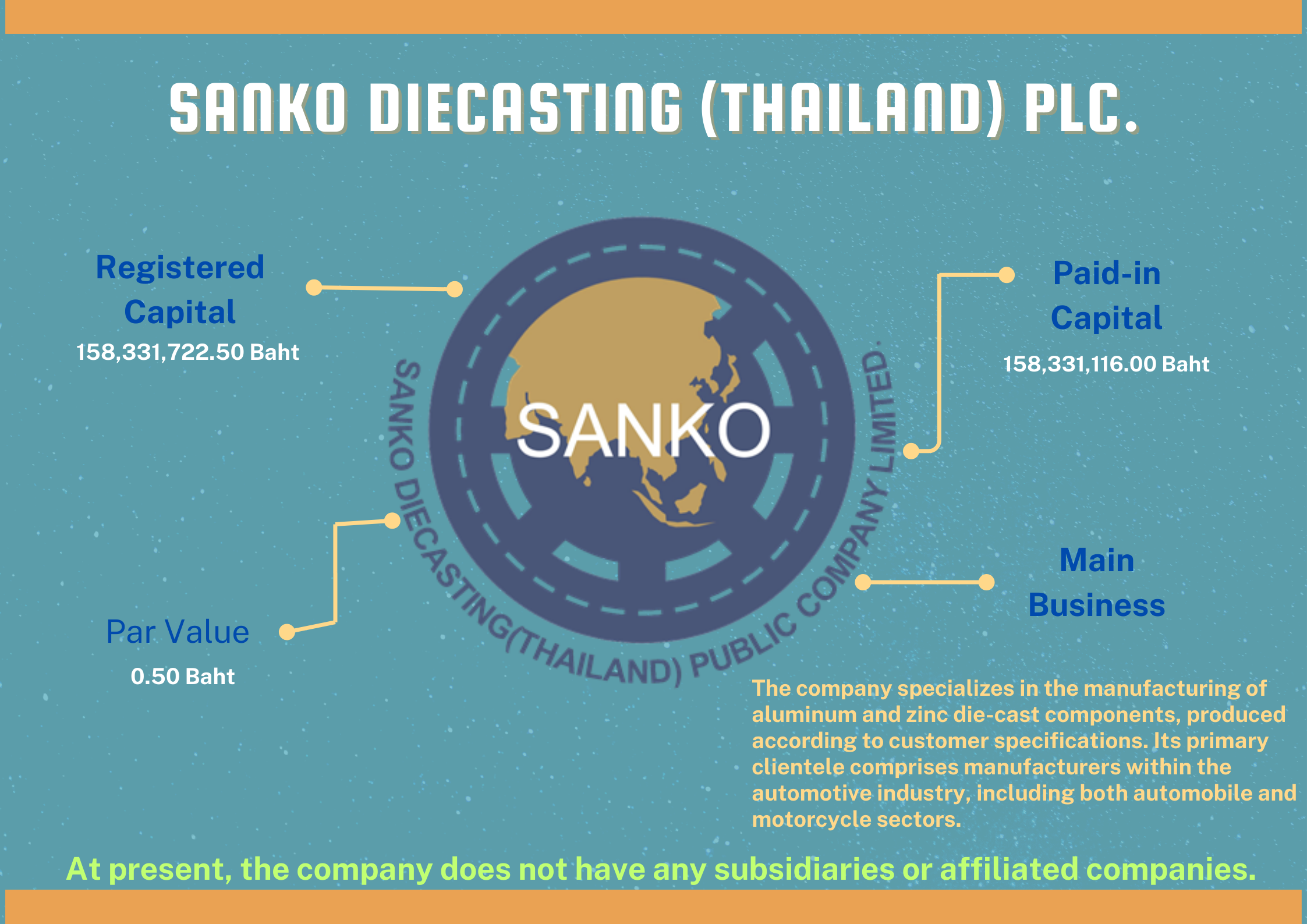
At present, the company does not have any subsidiaries or affiliated companies.
Income Structure
Introduction
Company’s revenue structure can be classified into major product lines from 2023 to 2025 as follows;
Product / Service Income
| Category | Description | This Year | This Year % | Last Year | Last Year % | 2 Years Ago | 2 Years Ago % |
|---|---|---|---|---|---|---|---|
| Total revenue from operations | Total revenue from operations | 722,976.73 | 100 | 816,266.54 | 100 | 760,952.11 | 100 |
| Alluminiam parts and Zinc parts | 691,149.38 | 95.6 | 763,038.62 | 93.48 | 717,584 | 94.3 | |
| Other | Others | 31,827.35 | 4.4 | 53,227.92 | 6.52 | 43,368.11 | 5.7 |
Export Income
| Category | Description | This Year | This Year % | Last Year | Last Year % | 2 Years Ago | 2 Years Ago % |
|---|---|---|---|---|---|---|---|
| Total revenue | Total revenue | 722,976.73 | 100 | 816,266.54 | 100 | 760,952.11 | 100 |
| Domestic | Domestic | 696,267.07 | 96.31 | 813,031.54 | 99.6 | 748,341.11 | 98.34 |
| International | International | 26,709.66 | 3.69 | 3,235 | 0.4 | 12,611 | 1.66 |
| Italy | Italy | 0 | 0 | 0 | 0 | 1,270 | 10.07 |
| United States of America | United States of America | 23,791.51 | 89.07 | 0 | 0 | 0 | 0 |
| Other countries | Others | 2,918.15 | 10.93 | 3,235 | 100 | 11,341 | 89.93 |
Other Income
| Operating Other Income | Non-Operating Other Income | Share of Profit |
|---|---|---|
| 1710 · As of year: 12644.32 · Description: Total other income · As of yesteryear: 13086.01 · As of year before yesteryear: 8615.67 · 1711 · As of year: 11963.63 · Description: Other income from operations · As of yesteryear: 12212.53 · As of year before yesteryear: 7686.83 · 10859.21 · Description: sale by product · As of yesteryear: 11770.53 · As of year before yesteryear: 7686.83 · 0.0 · Description: Gain on Exchange Rate · As of yesteryear: 122.25 · As of year before yesteryear: 0.0 · 1104.42 · Description: Other income · As of yesteryear: 319.75 · As of year before yesteryear: 0.0 | 1712 · As of year: 680.69 · Description: Other income not from operations · As of yesteryear: 873.48 · As of year before yesteryear: 928.84 · 680.68 · Description: Interest Receive · As of yesteryear: 873.48 · As of year before yesteryear: 928.84 · 0.0 · Description: Gain on Fixed assets sold · As of yesteryear: 0.0 · As of year before yesteryear: 0.0 | 1713 · As of year: 0.0 · Description: Share of profit · As of yesteryear: 0.0 · As of year before yesteryear: 0.0 |
Product / Service Characteristics
Business Type
3114
Business Groups
| Business Group | Description |
|---|---|
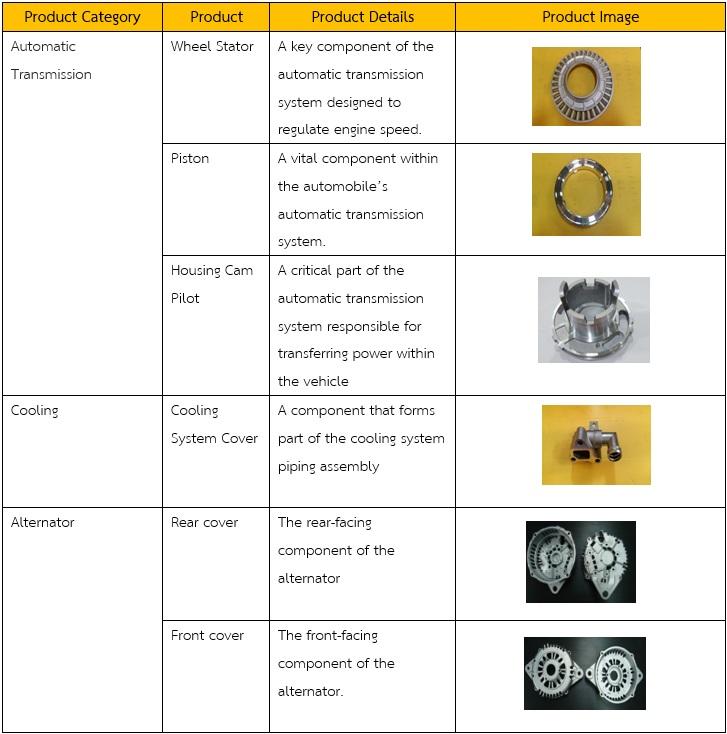
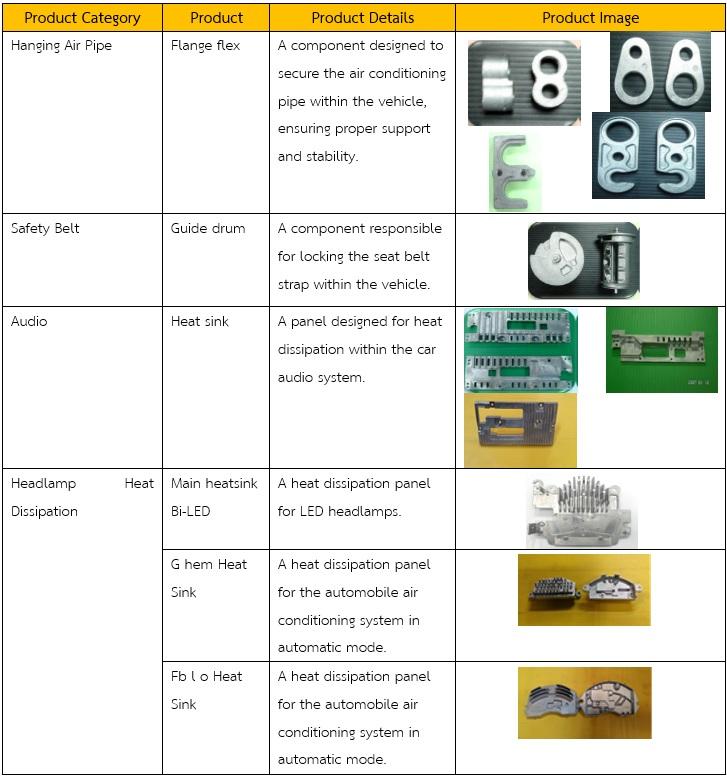
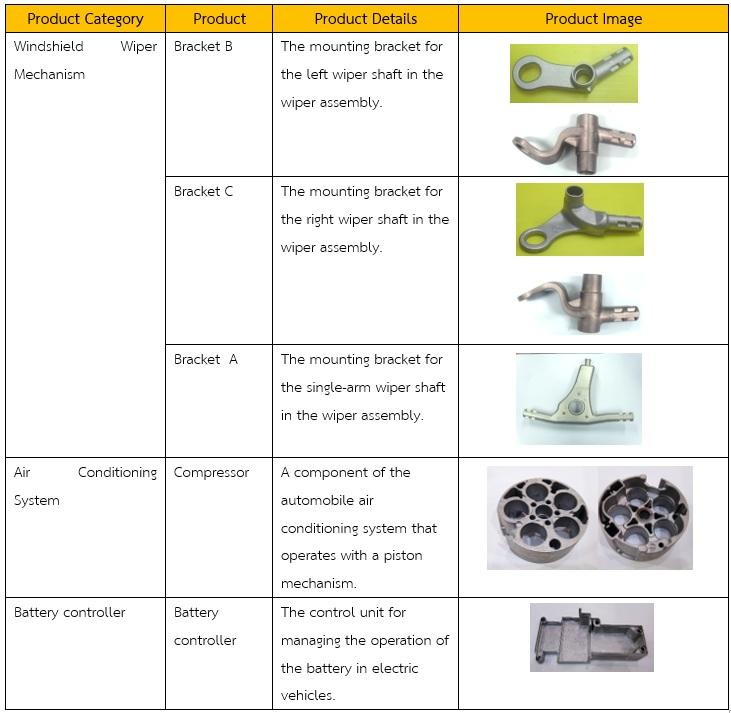
| Automotive | The products in this group are components and molds for automotive equipment and parts, which include Housing cam piot, Alternator, starters, Bracket compressor, air conditioning , air duct hangers for vehicles, and wiper motor control assemblies, among others. The main customers for these products are automotive parts manufacturers who assemble these components and equipment for further delivery to vehicle assembly companies. Revenue from this product group constitutes the primary income for the company. Automatic Transmission 1.Wheel Stator – A key component of the automatic transmission system designed to regulate engine speed. 2.Piston – A vital component within the automobile’s automatic transmission system. 3.Housing Cam Pilot – A critical part of the automatic transmission system responsible for transferring power within the vehicle. Cooling 1.Cooling System Cover – A component that forms part of the cooling system piping assembly. Alternator 1.Rear Cover – The rear-facing component of the alternator. 2.Front Cover – The front-facing component of the alternator.
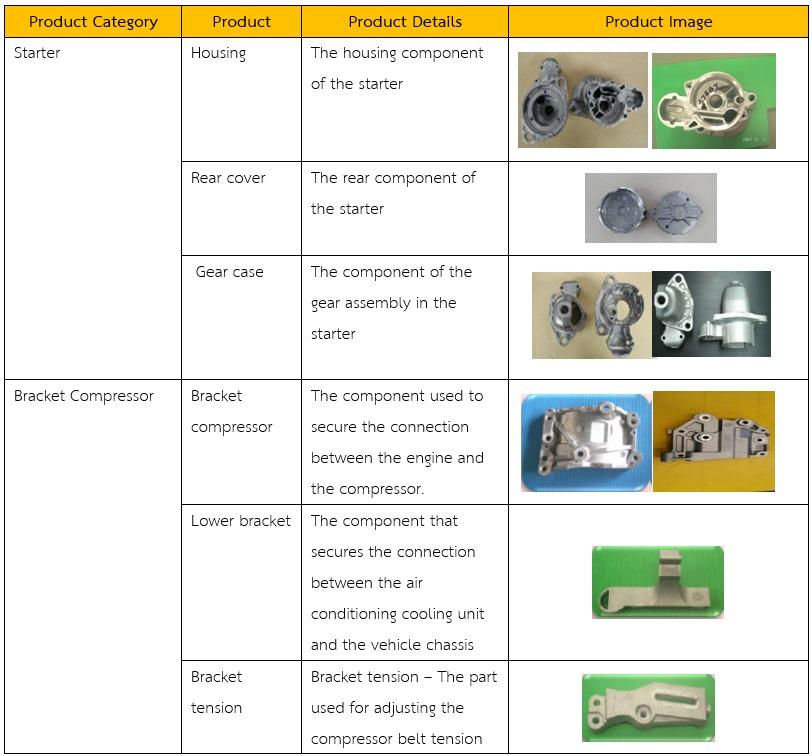
Starter 1.Housing – The housing component of the starter. 2.Rear Cover – The rear component of the starter. 3.Gear case – The component of the gear assembly in the starter. Bracket Compressor 1.Bracket Compressor – The component used to secure the connection between the engine and the compressor. 2.Lower bracket – The component that secures the connection between the air conditioning cooling unit and the vehicle chassis. 3.Bracket tension – The part used for adjusting the compressor belt tension.
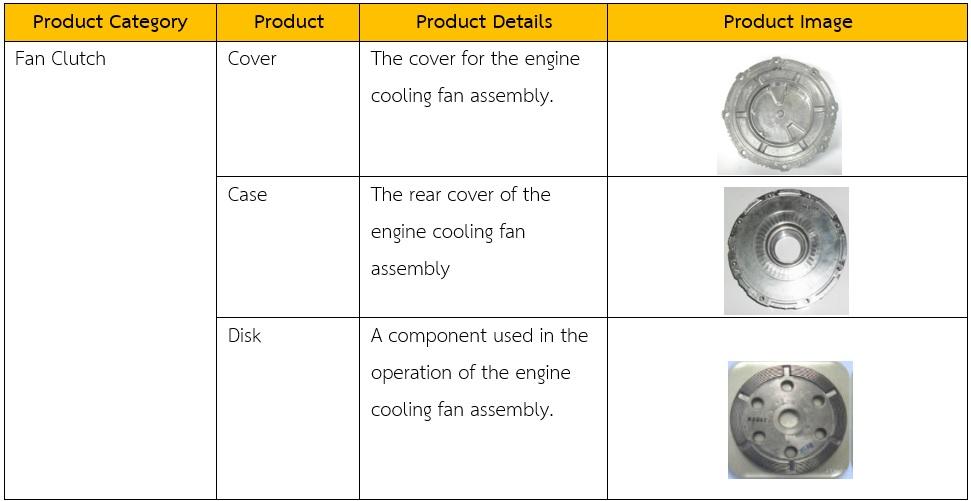
Fan Clutch 1.Cover – The cover for the engine cooling fan assembly. 2.Case – The rear cover of the engine cooling fan assembly. 3.Disk – A component used in the operation of the engine cooling fan assembly.
Hanging Air Pipe 1.Flange flex – A component designed to secure the air conditioning pipe within the vehicle, ensuring proper support and stability. Safety Belt 1.Guide drum – A component responsible for locking the seat belt strap within the vehicle. Audio 1.Heat sink – A panel designed for heat dissipation within the car audio system. Headlamp Heat Dissipation 1.Main heatsink Bi-LED – A heat dissipation panel for LED headlamps. 2.Ghem Heat Sink– A heat dissipation panel for the automobile air conditioning system in automatic mode. 3.Fblo Heat Sink – A heat dissipation panel for the automobile air conditioning system in automatic mode.
Windshield Wiper Mechanism 1.Bracket A – The mounting bracket for the single-arm wiper shaft in the wiper assembly. 2.Bracket B– The mounting bracket for the left wiper shaft in the wiper assembly. 3.Bracket C – The mounting bracket for the right wiper shaft in the wiper assembly. Air Conditioning System 1.Compressor– A component of the automobile air conditioning system that operates with a piston mechanism. Battery controller 1.Battery controller– The control unit for managing the operation of the battery in electric vehicles.
|
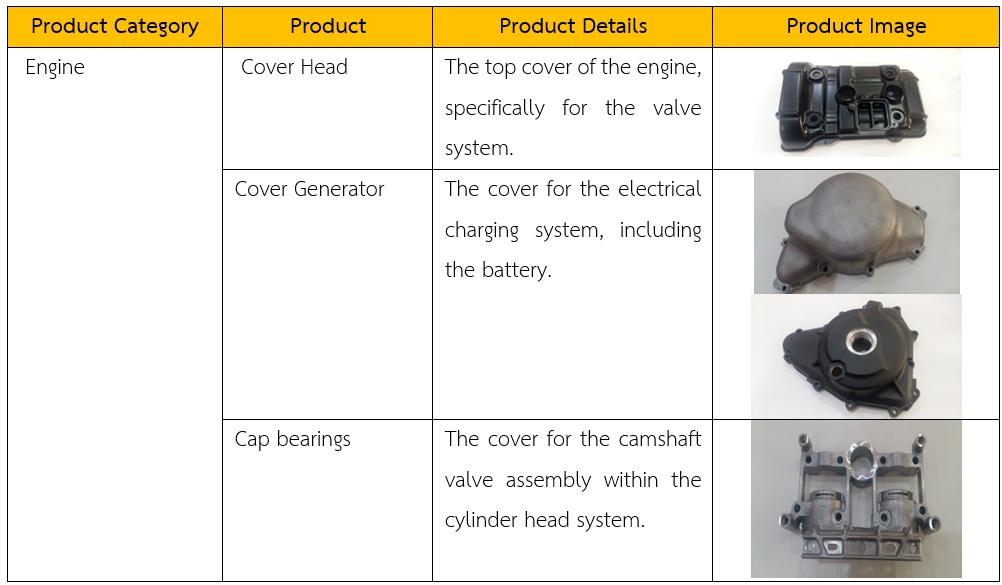
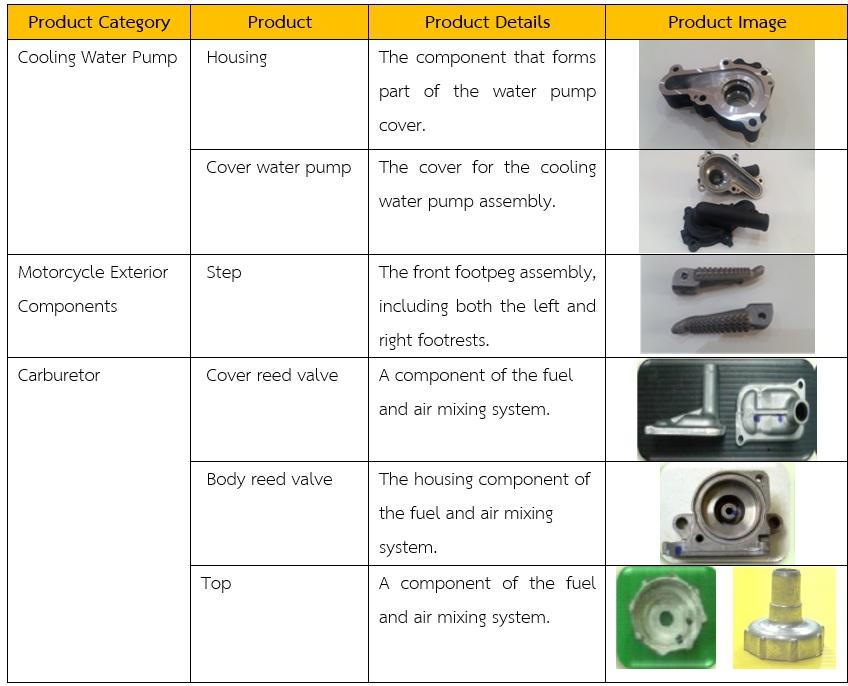
| Motorcycle | The products in this category consist of components and molds for motorcycle equipment and parts, including the clutch system, Carburetor, Starter , and Shock Absorber etc. The customer base for these products includes motorcycle parts manufacturing companies and motorcycle assembly companies.
1.Cover Head – The top cover of the engine, specifically for the valve system. 2.Cover Generator – The cover for the electrical charging system, including the battery. 3.Cap bearings – The cover for the camshaft valve assembly within the cylinder head system.
Cooling Water Pump 1.Housing– The component that forms part of the water pump cover. 2.Cover water pump – The cover for the cooling water pump assembly. Motorcycle Exterior Components 1.Step – The front footpeg assembly, including both the left and right footrests. Carburetor 1.Cover reed valve – A component of the fuel and air mixing system. 2.Body reed valve – The housing component of the fuel and air mixing system. 3.Top– A component of the fuel and air mixing system.
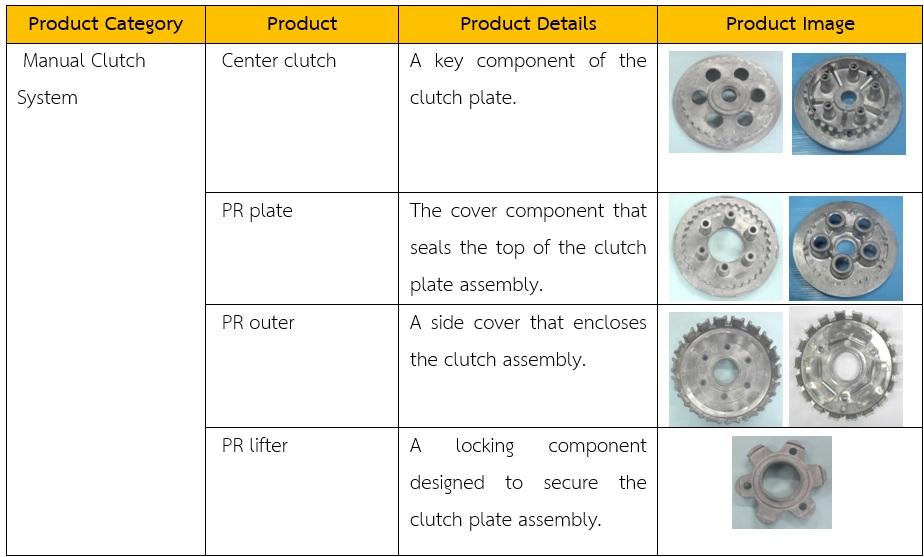
Manual Clutch 1.Center clutch – A key component of the clutch plate. 2.PR plate – The cover component that seals the top of the clutch plate assembly. 3.PR outer – A side cover that encloses the clutch assembly. 4.PR lifter – A locking component designed to secure the clutch plate assembly.
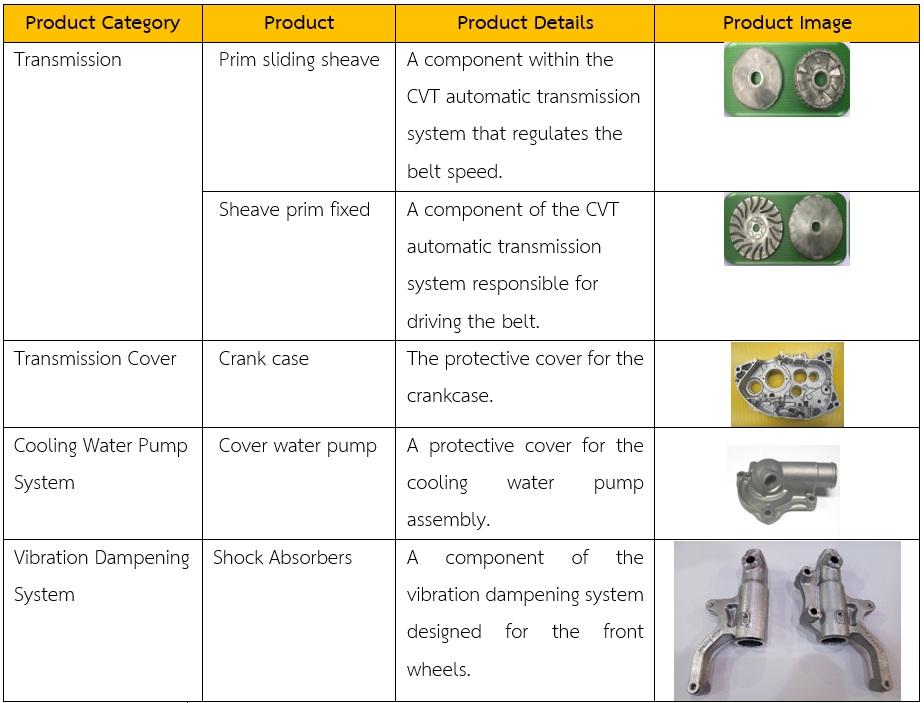
Transmission 1.Prim sliding sheave – A component within the CVT automatic transmission system that regulates the belt speed. 2.Sheave prim fixed – A component of the CVT automatic transmission system responsible for driving the belt. Transmission Cover 1.Crank case – The protective cover for the crankcase. Cooling Water Pump System 1.Cover water pump – A protective cover for the cooling water pump assembly. Vibration Dampening System 1.Shock Absorbers – A component of the vibration dampening system designed for the front wheels.
|
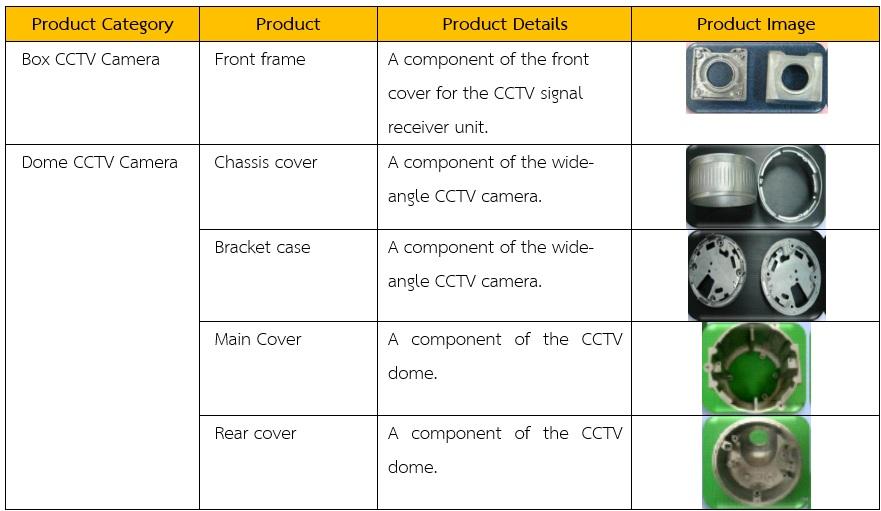
| Electric | The products in this category consist of components and molds for various electrical appliances, such as intercom, among others. The customer base for these products includes companies manufacturing electrical appliance components. CCTV 1.Front frame – A component of the front cover for the CCTV signal receiver unit. Dome CCTV Camera 1.Chassis cover – A component of the wide-angle CCTV camera. 2.Bracket case – A component of the wide-angle CCTV camera. 3.Main Cover – A component of the CCTV dome. 4.Rear cover – A component of the CCTV dome.
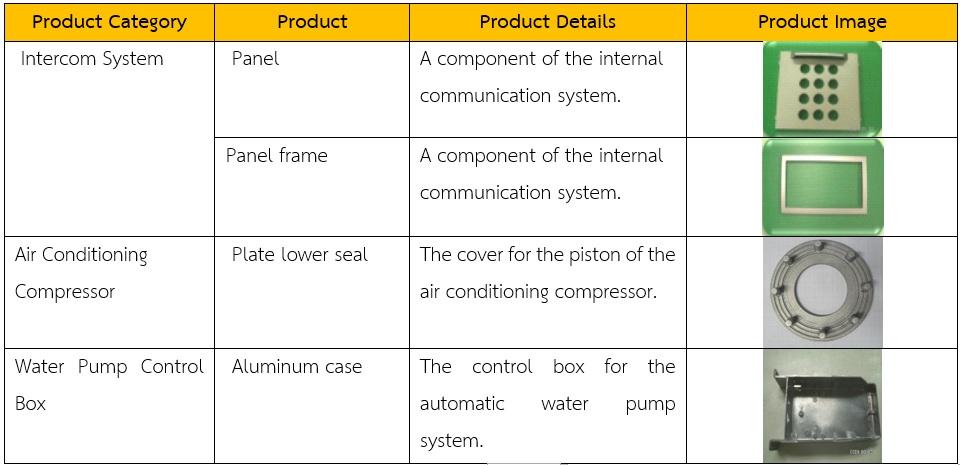
Intercom System 1.Panel– A component of the internal communication system. 2.Panel frame – A component of the internal communication system. Air Conditioning Compressor 1.Plate lower seal – The cover for the piston of the air conditioning compressor. Water Pump Control Box 1.Aluminum case – The control box for the automatic water pump system.
|
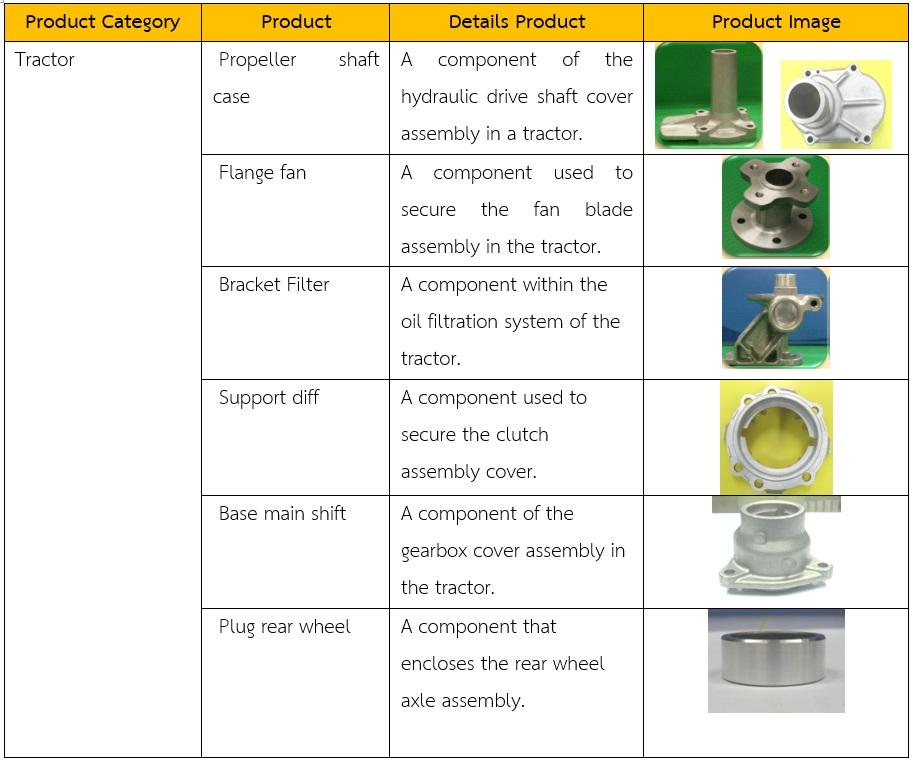
| Agriculture | The products in this category consist of agricultural machinery parts, such as tractor components, as well as parts for other industries, such as fuel dispenser nozzles for gas stations, among others. The customer base for these products includes companies manufacturing agricultural machinery and other industrial equipment. Tractor 1.Propeller shaft case – A component of the hydraulic drive shaft cover assembly in a tractor. 2.Flange fan – A component used to secure the fan blade assembly in the tractor. 3.Bracket Filter – A component within the oil filtration system of the tractor. 4.Support diff– A component used to secure the clutch assembly cover. 5.Base main shift – A component of the gearbox cover assembly in the tractor. 6.Plug rear wheel– A component that encloses the rear wheel axle assembly.
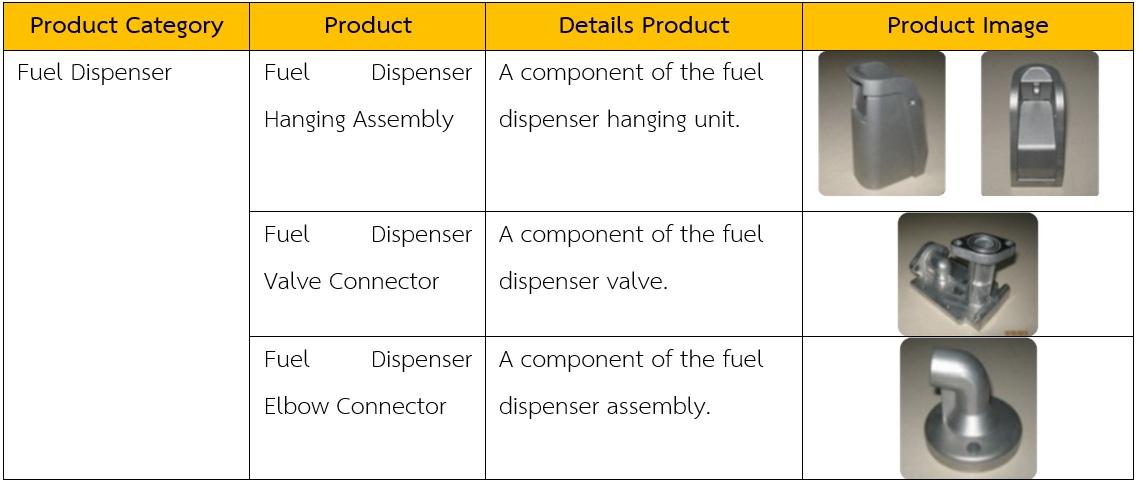
Fuel Dispenser 1.Fuel Dispenser Hanging Assembly – A component of the fuel dispenser hanging unit. 2.Fuel Dispenser Valve Connector – A component of the fuel dispenser valve. 3.Fuel Dispenser Elbow Connector – A component of the fuel dispenser assembly.
|
| Loss Wax Casting | This product group consists of castings made to specific designs and interior decorative accessories, utilizing various casting techniques such as sand casting and lost-wax casting. These methods are employed to meet the diverse needs of customers, including interior home decor, jewelry, machine parts. |
Research & Development
Has R&D Policy (Y/N)
Yes
R&D Cost — Description
The Company’s Research and Development
1. Improving the production process.
1.1 Incorporating new technology by including Oxygen into the Aluminum casting process (Pore Free Casting, PF) to reduce the pores within the work piece.
1.2 Improving the quality of the materials by adding Magnesium (Mg) in the casting process to increase the strength and durability according to the customer’s demands.
1.3 Controlling the quality of the goods by using the X-ray machine to inspect the pores and guarantee the quality of the products before delivering to the customers.
2. Developing new products
In order to increase business variety. The Company had developed new products which are home decorations.
and other products besides the automotive industry utilizes various casting methods. The Company takes charge from the designing process, production, quality control, utilities and setting the price according to the market.
3. Using innovation to expand the customer’s base. Currently the Company is a member of Markline in order to research and gather customers’ data in the automobile industry from all over the World and expand its customers base in the ASEAN market and also in the European, USA and Japan market as well.
R&D Cost — Label
Research and development (R&D) expenses over the past 3 years (Million Baht)
R&D Cost — This Year
0.48
R&D Cost — Last Year
0.62
R&D Cost — 2 Years Ago
0.72
Assets Used in the Business
Permanent Assets — Description
The main assets used in business operations include land, buildings, and equipment, which are valued at cost less accumulated depreciation and impairment (if any).
Permanent Assets — Appraisal
| Asset | Ownership | Obligation | Appraisal Value |
|---|---|---|---|
| LAND | Owned assets | MORTGAGE WITH BANK | 59,769,921 |
| PLANT | Owned assets | MORTGAGE WITH BANK | 71,692,919 |
Intangible Assets — Description
Computer Software. The Company initially recognizes other intangible assets acquired in other cases are recognized at cost. Following the initial recognition, the intangible assets are carried at cost less any accumulated amortization and any allowance for impairment losses (if any).
Intangible Assets — Appraisal
| Asset | Type | Appraisal Value |
|---|---|---|
| Computer Software | Software | 1,465,019 |
Has Subsidiaries Investment Policy (Y/N)
No
Marketing Policy & Competition
Reporting Mode
3117
Marketing Policy (Overall)
The company operates in the business of manufacturing aluminum die-cast parts and zinc die-cast parts for customers in various industrial sectors. The main industries served include the automotive industry, home appliance industry, and agricultural machinery parts industry. Competition in the main industries is quite high. Therefore, the company’s competitive policy or strategy is to produce all types of products according to the quality specified by the customers at reasonable market prices. Pricing is based on production costs plus standard profit margins and is referenced to market prices. The company’s customer base includes automotive parts manufacturers, motorcycle manufacturers and distributors, home appliance parts manufacturers, and manufacturers and distributors of agricultural machinery.
Sales and Distribution Channels: The distribution channels are divided into two main groups:
1. Direct Sales to Tier 1 Suppliers: The majority of products are sold directly to Tier 1 suppliers, primarily operating in Thailand through the company’s marketing and sales team. This team consists of both Thai and foreign staff with more than 30 years of experience. The team is divided into groups responsible for finding new customers and managing current customers. The team directly communicates with customers, studies their needs, and may collaborate to modify product designs based on customer approval if necessary, to improve production efficiency and feasibility, while maintaining the product’s specifications and intended use.
2.Other Distribution Channels:
1) Advertising and Promotion: The company promotes its products through various media such as industry directories and journals related to the industries and parts it manufactures, such as the Thai Automotive Industry Directory. Additionally, the company has developed a website, www.sankothai.net, to increase communication channels with customers and serve as an additional promotional tool for the company.
2) Membership in Industry Associations: The company is a member of the Thai Automotive Parts Manufacturers Association, the Automotive Institute, and other associations related to the automotive industry to increase opportunities for networking and engaging with target customers.
3) Online Automotive Portal: The company uses an online automotive portal to publish a database of leading automotive parts suppliers for use by industry experts, senior executives, consultants, researchers, etc., who are involved in the manufacturing and assembly of automotive parts.
In 2025,the focus on the expansion of the automotive industry, which is becoming increasingly diversified, includes hybrid engines, electric vehicle (EV) engines, plug-in hybrid electric vehicle (PHEV) engines, and more. Additionally, the production of components compatible with both traditional internal combustion engines and alternative energy engines is being emphasized. The market expansion also extends to new industries, such as e-bikes, furniture, and home decor.
Industry & Competition (Overall)
The domestic market in 2025 is projected to remain stable at -0.5% to 0.5% per year. And a shrinking export market, amid supply chain risks that could be disrupted by trade conflicts. Domestic sales are expected to grow 1.0–2.0% per year, although a contraction is still likely in 2025 amid economic uncertainty, weaker consumer confidence and spending, lower agricultural prices, and potential delays in government budget disbursement in the second half. Sales are anticipated to stabilize in 2026 before recovering in 2027, supported by:
1) Infrastructure investment that will gradually revive private sector spending.
2) Continued expansion in tourism, transport, and e-commerce.
3) Rising used-car prices encouraging new car purchases.
4) And the launch of new EV models. By contrast, exports are expected to decline by -1.3% to -2.3% annually, weighed down by slow demand recovery among trading partners and intensifying competition from Chinese automakers, which is expected to erode Thailand’s export market share. Exports in 2025–2026 are likely to be particularly affected by U.S. tariff measures and tightening environmental standards across many countries.
Factors Influencing the Thai Automotive Industry in 2025
1) Economic Conditions
- The high levels of debt within both the business and household sectors, combined with an increasing trend in non-performing loans (NPLs), are having a direct impact on consumer purchasing power, which in turn is contributing to a decline in domestic vehicle sales.
- More stringent vehicle loan approval processes are being implemented due to rising loan amounts and the growing number of bad debts.
- The second-hand car market is experiencing a price decline as a result of an oversupply of vehicles.
- The ongoing escalation and protracted nature of international conflicts, particularly the Russia-Ukraine war, continue to exert pressure on the broader economy.
2) Policies and Regulations in the Automotive Sector
- The enforcement of Euro 5 emissions standards for both vehicles and fuels, effective from January 1, 2024, is expected to lead to higher vehicle and fuel prices.
- The EV3.5 scheme supporting BEVs and the excise tax reduction measure promoting HEV production, Thailand’s investment promotion in the automotive value chain, covering both vehicle and part production, rose 5.0% YoY to THB 47.0 billion. A total of 137 projects received investment promotion, up 12.3% YoY, with most focusing on HEV and MHEV production, as well as high-value parts manufacturing to support these vehicles.
- The government’s commitment to achieving a Carbon Neutrality Society by 2050, as outlined during the COP26 conference in 2021, is driving the development of the Clean Air Act and the Climate Change Act.
3) International Trade
The U.S. tariff hikes, which exert both direct and indirect impacts. These consist of:
- Direct impacts from the U.S. sectoral tariff increase on automobiles and parts to 25%, effective April 3, 2025
- Indirect impacts from reciprocal tariffs, which have weakened purchasing power in export markets as U.S. trading partners face varying tariff hikes effective from August 7, 2025
- Intensifying competition from Chinese automakers, who are aggressively offloading excess EV supply, especially in developing markets where affordable Chinese EVs are gaining popularity
- Thailand currently holds 15 free trade agreements with 19 partner countries, with ongoing negotiations for 5 additional agreements. Notable agreements that will support the Thai automotive industry include those with the European Union, the European Free Trade Association (EFTA), and South Korea.
- Increasingly stringent environmental standards in many countries, which may affect exports of certain ICE models from Thailand
Future for Electric Vehicles (EVs) in ThailandThe electric vehicle (EV) market in Thailand is expected to experience continued growth, with projected registration numbers ranging between 100,000 to 120,000 units, the majority of which will be passenger vehicles. This growth is primarily driven by public awareness of the need to address global warming through the adoption of EVs, as well as the incentives provided by the government to promote EV use.Furthermore, Mr. Suwatch emphasized that “Thailand has long been a production base for internal combustion engine (ICE) vehicles, establishing a robust supply and value chain that encompasses the entire industry from upstream to downstream, while also generating significant employment. As such, maintaining the ICE vehicle production base is critical during the transition to electric vehicles (EVs). The Thai Automotive Industry Association is fully committed to supporting and collaborating in the creation of a carbon-neutral society, reducing emissions, and protecting the environment, offering more sustainable options for consumers in alignment with the government’s 'Carbon Neutrality Goal by 2050.' This commitment is reflected in policies such as 30@30, which seeks to increase the production and use of zero-emission vehicles, and the restructuring of excise tax on new vehicles in 2026 to encourage the production of environmentally friendly vehicles.”
Thai Automotive Industry 2025
Automotive Industry
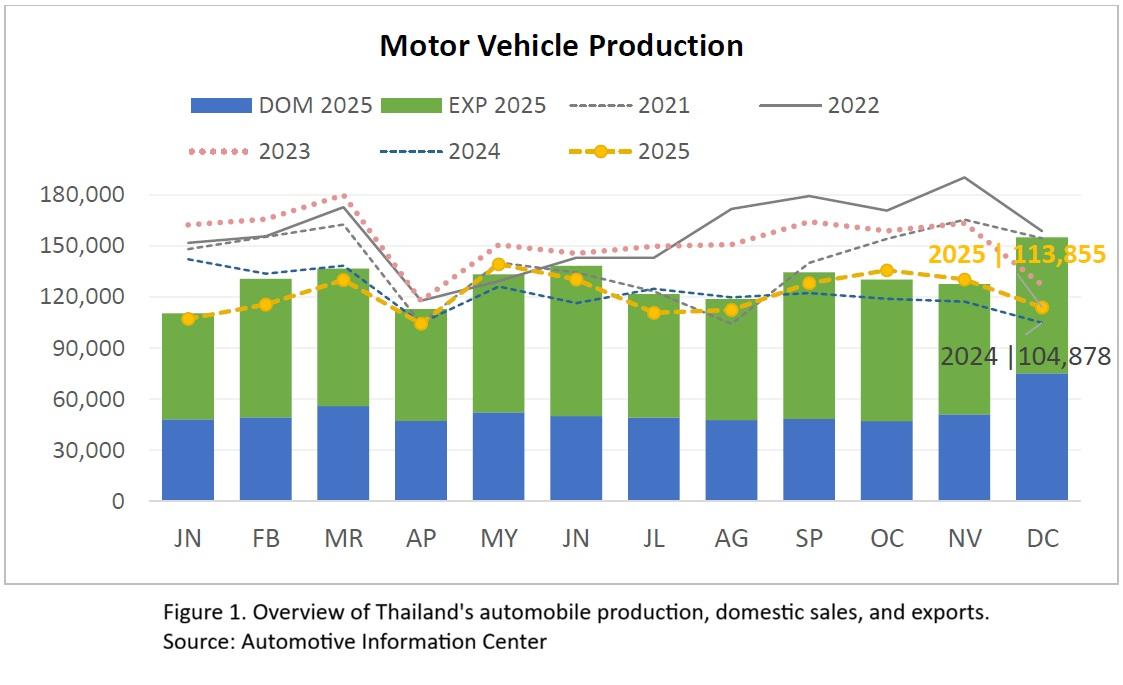
In 2025, Thailand's automotive industry saw a 1% decline in production compared to the previous year, with total output reaching 1,455,569 units. This figure fell slightly short of the 1,450,000-unit target due to economic slowdowns in key trading partners and stricter carbon emission regulations abroad. Furthermore, intense competition from Chinese electric vehicle (EV) manufacturers—leveraging excess capacity and price advantages—led to a 9% drop in exports, totaling 924,410 units, which was below the projected 950,000 units. Domestically, the market faced pressure from financial institutions tightening loan approvals as household debt remained high at 90% of GDP. Despite these challenges, domestic vehicle sales in 2025 reached 621,212 units, representing an 8% increase from the year before.
Source: Automotive Information Center.
Motorcycle Industry
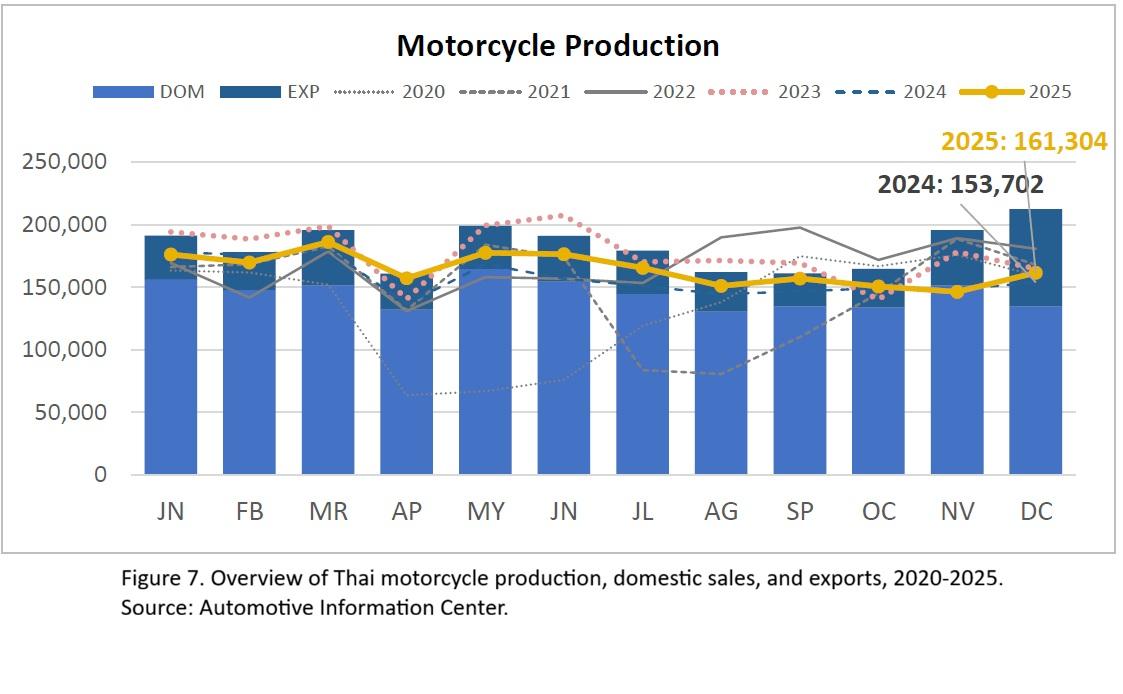
In 2025, Thailand's motorcycle industry saw an increase in production compared to the previous year. Total production reached 1,972,902 units, which was below the projected target of 2,100,000 units due to the country's economic slowdown impacting consumer purchasing power. This trend was reflected in domestic sales for 2024, which grew by 5% year-on-year to 1,887,208 units, also falling short of the 2,100,000-unit target. Additionally, exports of Completely Built-Up (CBU) motorcycles contracted by 3% compared to the prior year, resulting in a total export volume of 389,353 units in 2025.
Source: Automotive Information Center.
Electronics Industry
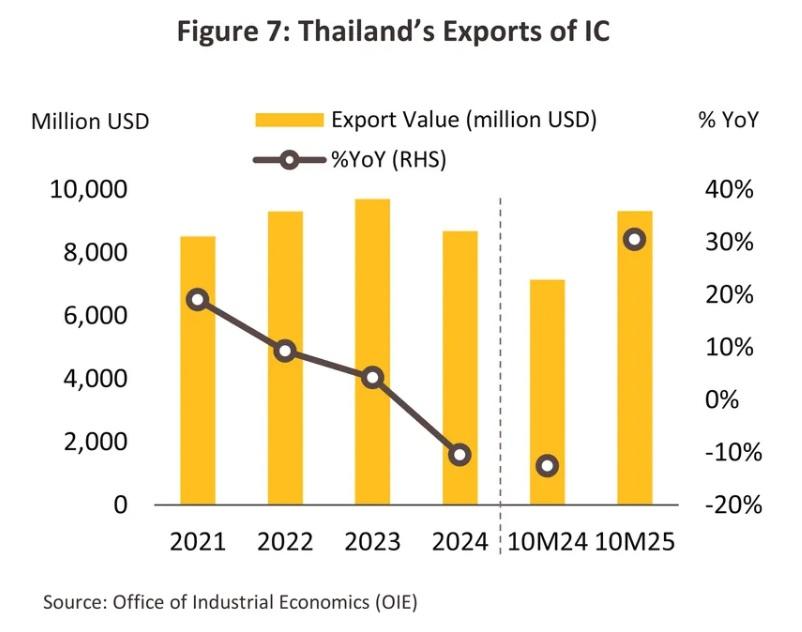
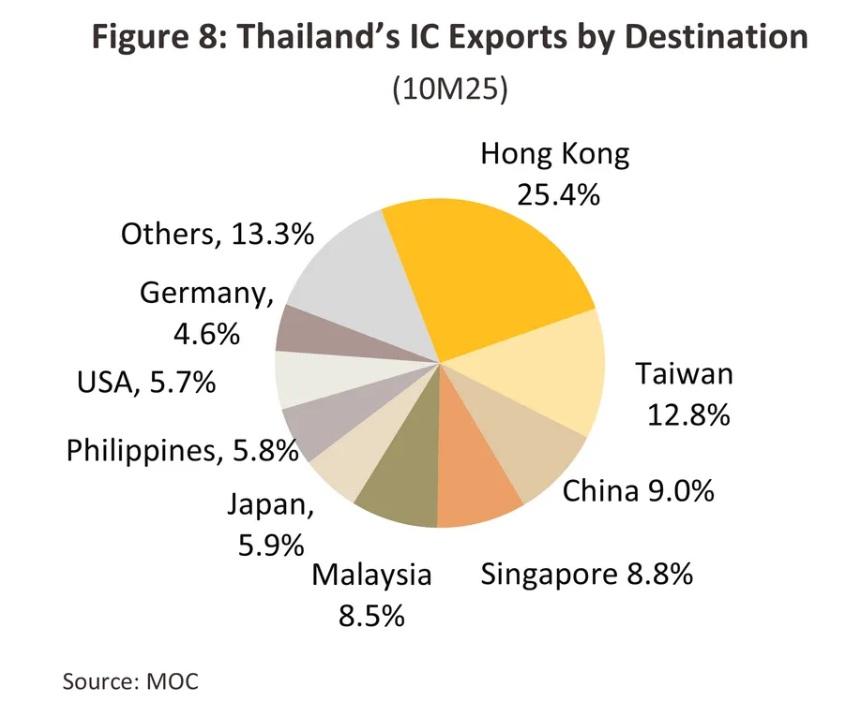
In 2025, Thailand's electronics industry is projected to recover, driven by two key sectors: 1) The Printed Circuit Board (PCB) industry, with production and export value expected to grow by an average of 6.0–7.0% and 8.0–9.0% annually, respectively; and 2) The Hard Disk Drive (HDD) industry, with production and export value anticipated to increase by 7.0–8.0% and 8.5–9.5% annually. Supporting factors include a new global replacement cycle for electrical and electronic appliances, the continued growth of electric vehicle (EV) production and digital services, and the advancement of AI technology, which bolsters demand for processing and data storage devices. However, the industry faces persistent challenges, including the rising popularity of SSDs and intensifying competitive pressures from US-China trade tensions and tech wars. Consequently, Thai manufacturers may face stiff competition from Chinese imports and risk losing market share to Chinese electronic products in export markets.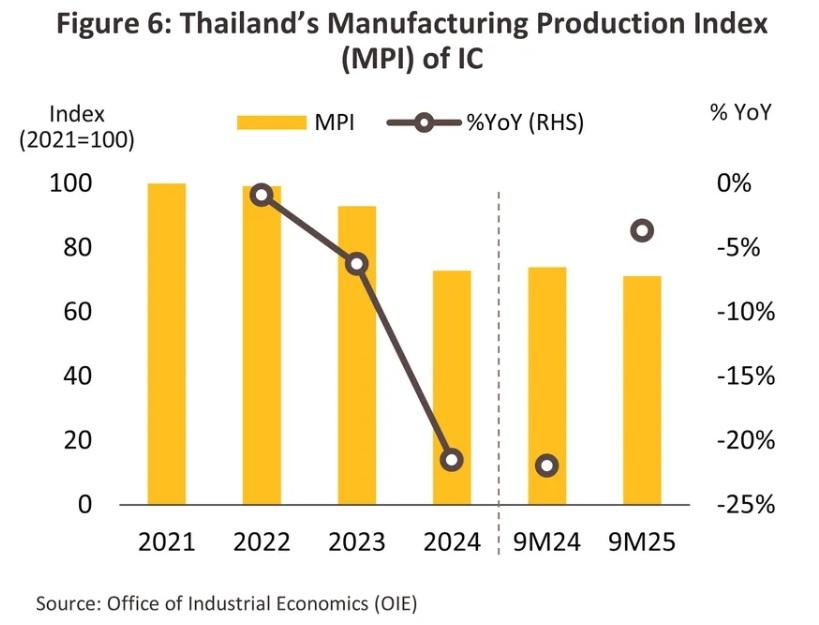
Agricultural Industry
In 2025, Thailand's agricultural machinery market is projected to return to a growth rate of 3.0–4.0% annually. This recovery is driven by several key factors: Favorable Climate: The onset of La Nina is expected to bring increased rainfall, improving water availability and encouraging the expansion of cultivated areas. Modernization & Labor Solutions: Government support for smart farming is intensifying to address labor shortages caused by an aging society. Environmental Regulations: Stricter green standards from major trading partners, particularly the European Union, are boosting demand for advanced, eco-friendly machinery. These drivers will stimulate both domestic and international market value, benefiting manufacturers and distributors throughout the entire supply chain.
Procurement of Products & Services
Reporting Mode
3117
Procurement (Overall)
The Company produces Aluminum and Zinc parts as ordered by the customers. The Company will then receive a drawing or product samples and estimate the production quantity in order to work out the capability in designing the molds and the possibility of producing the parts as ordered. After that, the Company will analyze the costs in designing the molds, costs of making the molds and costs of production, and then the quotation of the parts and/or the molds will be offered to the customers for consideration, depending on the nature of the employment. As soon as the customers approve of the quotation, the Company will take the plans or product samples to design the molds by using computer programs to calculate and display the molds in 3D, and send it off to the molds producing companies to quote the price back to the Company. Once the molds producing companies have been chosen, the molds will take 3 months to produce. When the molds have been completed, the Company, together with the customers, will inspect the molds together by extruding with the molds made, and test the produced sample parts with Co-ordinate Measuring Machine (CMM). After the tests, the parts will be brought to the customers for quality check and further test it by assembling with other parts
Raw Material Acquisition (Overall)
Acquiring the Ingredients for Production
The Company is the producer of Aluminum and Zinc diecasting parts as ordered by the customers. Aluminum and Zinc that the Company uses are Aluminum alloy and Zinc alloy. Aluminum and Zinc have the mixtures of other elements making it unique and has the suitability for various types of work. Therefore, the ratio of ordering the ingredient will depend on the volume of the orders. In the past, the majority of work that the Company has done have been Aluminum parts where the Company orders from 13 domestic retailers. Since the Company has the policy of spread ordering to reduce the risk of relying heavily on any particular retailer, the orders of ingredient will spread over many retailers with the different volume ordered, depending on the price of each retailer. The Company receives a monthly quotation by the retailers for the change in price of the ingredient.
For the ingredient selection process, the Company pays great attention to the quality of the ingredient. The ingredient ordered must be at the exact level of standard indicated, which the company will proceed to check for the quality with the guarantee certificate of the retailer that comes together every time upon ordering the ingredient. After that, the Company will take a portion of the ingredient to test and see whether or not it is in accordance with the certificate. With an examination period 1-2 days.
To select an ingredient retailer, the Company will evaluate whether or not the retailers had passed the requirements of the Company and then collect the lists of those who passed in the ingredient retailer lists. Every time there is a purchase, the Company will compare the price with at least 2 other retailers from the lists to ensure that the ingredients bought are of the best quality and at the best price. The list of ingredient retailers will be revised annually.
Production Policy (Overall)
Production capacity in 2025 will increase due to supporting factors from economic activities. The combustion engine group still has orders that do not decrease so much. The company has a plan to develop and improve the efficiency of the machinery all the time. And has adjusted the production capacity and production volume to be consistent with customer needs every year to develop quality and customer satisfaction.
Distributors (Overall)
Each supplier raw material has a purchase value not exceeding 10 percent of the total purchase amount according to the consolidated financial statements because it is a way to spread the risk of monopoly trade. Each has always had a good relationship and has been trading with each other for more than 5 years.
Number of Raw-Material Distributors (Overall)
7
Production Capacity (Overall)
| Item | Unit | Used | Capacity |
|---|---|---|---|
| METALCOM CO.,LTD. | Ton | 99.89 | 2,343 |
Domestic/Overseas Purchase Proportion (Overall)
| Raw Material | Source Country | Value |
|---|---|---|
| ALUMINIUM INGOT ADC12 / ADC 3 / AC4C | Thailand | 200,571,221.55 |
| Zinc | Thailand | 3,004,181.32 |
Product Information — Overview
Introduction
Company Business Overview
The company specializes in the manufacturing of aluminum and zinc die-cast components, produced according to customer specifications. Its primary clientele comprises manufacturers within the automotive industry, including both automobile and motorcycle sectors. The company benefits from a stable order flow in the automotive parts segment, as orders for components related to a specific vehicle model typically persist until the model is discontinued, which generally spans a period of three years or more.Additionally, the company produces components for closed-circuit television (CCTV) cameras, video cameras, and intercom systems, catering to the electronics industry. It also manufactures parts for lawn mowers and tractors, serving the agricultural machinery sector. In the course of producing these components, the company offers comprehensive design services and has the capability to source molds to fully address the needs of its clients. At present, the company does not have any subsidiaries or affiliated companies.
Product and Service Description
The company specializes in the production of aluminum and zinc components, tailored to customer specifications, utilizing both high-pressure die casting and gravity casting processes.
1. High-Pressure Diecasting (HPDC)
2. Gravity CastingAdditionally, the company offers design services and collaborates with mold manufacturers to produce molds that meet customer requirements. Ownership of the molds is determined by agreements between the company and each customer,
which can be classified as follows:
1) Design and Sale of MoldsUnder this arrangement, the company designs and manufactures the molds, which are then sold to the customer. The ownership of the molds is transferred to the customer, who subsequently contracts the company to produce components using these molds.
2) Design of Molds and Production of ComponentsIn this case, the customer engages the company to both design the molds and produce components from them. Ownership of the molds remains with the company, which charges an additional profit margin to cover the costs of mold design and manufacturing.The company derives the majority of its revenue from the sale of aluminum components and molds.
Revenue from component sales is categorized into income from aluminum and zinc parts. The company’s products are further classified according to their specific applications as follows:
Projects Under Construction
Has Projects Under Construction (Y/N)
No
Debentures & Bills of Exchange
Has Debentures (Y/N)
No
Convertible Securities
Has Convertible Securities (Y/N)
No